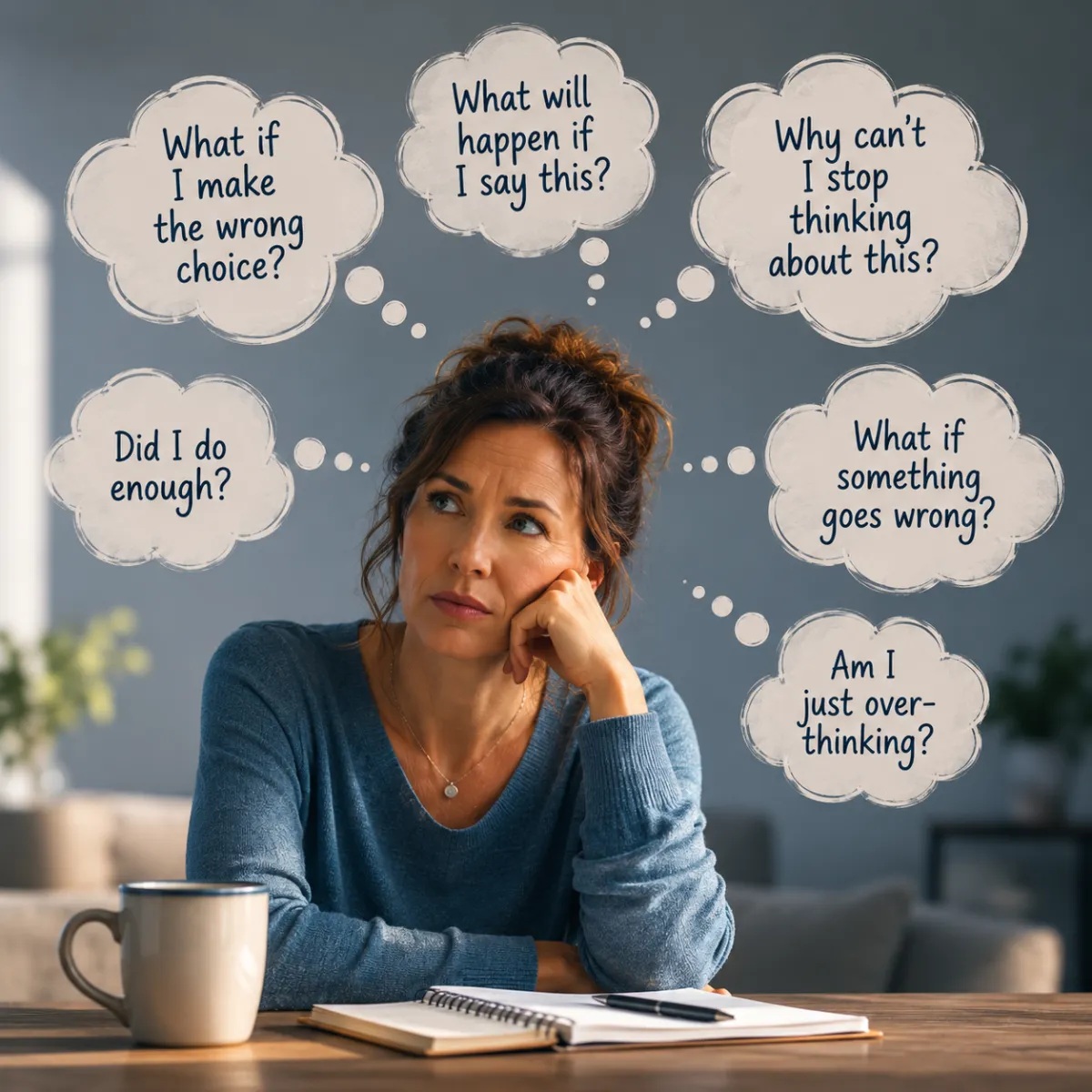
How Overthinking Creates Anxiety
Many people assume overthinking and anxiety are separate issues. They aren't.
In fact, one of the most common patterns I see as a coach and clinical hypnotherapist is that overthinking often creates anxiety, intensifies anxiety, and keeps anxiety alive long after a situation has passed.
The interesting part is that overthinking usually begins with good intentions. The problem is that at some point, productive thinking can quietly turn into overthinking. And once that happens, the brain often shifts from solving problems to creating them.
What Is Overthinking?
Overthinking is more than simply thinking carefully. It involves repeatedly analyzing, questioning, reviewing, and reconsidering situations long after additional thinking has stopped being useful.
You may find yourself:
Replaying conversations after they are over
Researching every possible option before making a decision
Imagining multiple worst-case scenarios
Reviewing past mistakes repeatedly
Struggling to stop thinking when you want to rest
Most people who overthink don't do it because they enjoy worrying. They do it because they are trying to create certainty. The challenge is that life rarely offers complete certainty.
Why do I know a lot about overthinking? Because for most of my life I was a top-notch overthinker. I would play things out this way and that way in my mind. I would postpone decision-making or taking action because, if I just thought about it a little more, I would surely be more clear or confident about what to do. Sound familiar?
Why the Brain Starts Overthinking
Your brain has one primary job: keep you safe. When faced with uncertainty, the brain often assumes that more information will help.
More research. More analysis. More preparation. More consideration.
Sometimes that works. Often it doesn't.
The brain begins acting as if there is one perfect answer hidden somewhere, and if you just think long enough, you'll find it.
Unfortunately, many of life's biggest decisions don't work that way. Overthinking about relationships, career choices, business decisions, parenting, leadership, or even what to say in an email often just spins you in circles. You feel busy because your mind is working so hard, but despite all that effort, you don't actually move any closer to a decision.
How Overthinking Creates Anxiety
1. Overthinking Keeps the Brain Focused on Potential Threats
When you repeatedly think about what could go wrong, your nervous system begins treating those possibilities as real dangers.
Questions such as:
What if I fail?
What if they don't like me?
What if I make the wrong decision?
What if something bad happens?
may feel like harmless mental exercises.
To your nervous system, however, they often feel like warnings. The more time you spend scanning for threats, the more threats you tend to find.
2. Overthinking Prevents Resolution
Anxiety often decreases when we make a decision and move forward. Overthinking delays that process.
Instead of choosing a direction, the brain remains trapped in uncertainty.
The issue isn't that you haven't thought enough. It's that you haven't allowed yourself to stop thinking. Many overthinkers secretly believe that one more round of analysis will finally make them feel certain. Unfortunately, certainty rarely arrives that way.
3. Overthinking Creates Mental Exhaustion
Thinking requires energy. Constant thinking requires a lot of energy.
Many chronic overthinkers describe feeling mentally exhausted even when they haven't done anything physically demanding.
They struggle with:
Mental fatigue
Irritability
Difficulty concentrating
Trouble sleeping
Feeling overwhelmed
Eventually the exhaustion itself can begin to feel like anxiety.
4. Overthinking Trains the Brain to Expect Problems
The brain learns through repetition. When you spend years searching for potential problems, your brain becomes very skilled at finding them.
You may begin noticing risks faster than opportunities. You notice threats before possibilities.
Over time, this can create a persistent feeling that something is wrong, even when life is going reasonably well.
Why Smart People Often Overthink
One of the biggest misconceptions about anxiety is that it primarily affects people who aren't thinking clearly.
Many of the strongest overthinkers I know are highly intelligent, thoughtful, capable and conscientious people. They see multiple possibilities, multiple outcomes, and multiple variables.
The downside is that they can become trapped in endless analysis. Their intelligence gives them more possible scenarios to evaluate. More possibilities can feel like more control. In reality, it often creates more uncertainty.
Signs That Overthinking May Be Fueling Your Anxiety
You may be caught in an overthinking cycle if you:
Have difficulty making decisions
Frequently seek reassurance
Replay conversations after they happen
Lie awake thinking at night
Research endlessly before taking action
Feel mentally exhausted by everyday decisions
If several of these sound familiar, overthinking may be contributing more to your anxiety than you realize.
Breaking the Cycle
The goal is not to stop thinking. The goal is to stop believing that every uncertainty can be eliminated before you act.
Many people benefit from:
Setting limits on decision-making time
Taking small actions before they feel fully ready
Practicing mindfulness
Challenging catastrophic thinking
Learning to tolerate uncertainty
The ability to move forward despite uncertainty is often more valuable than achieving certainty itself.
How Hypnosis Can Help
One reason hypnosis can be helpful for overthinking is that it works with the patterns beneath conscious thought.
Many overthinkers understand logically that their thinking isn't helping. The problem isn't knowledge. The problem is habit.
Hypnosis can help quiet mental noise, strengthen trust in yourself, and create new automatic responses to uncertainty.
Rather than getting trapped in endless analysis, many people find it easier to feel calm, clear, and decisive.
Final Thoughts
Overthinking often begins as an attempt to stay safe.
Ironically, it can create the very anxiety we are trying to avoid.
The goal isn't to become careless or stop thinking altogether – it is to recognize when thinking has stopped serving you.
When you learn to trust yourself, tolerate uncertainty, and take action without needing every answer in advance, both overthinking and anxiety often begin to lose their grip.
While I consider myself a very thoughtful and thorough person, I recognize I have come a long way in my personal battle to combat overthinking. I still overthink from time to time, but it is no longer the detrimental habit it used to be. If you're a chronic overthinker, don't assume this is simply who you are. Overthinking is a habit, not an identity. Change is possible.
If you are plagued by overthinking, or it is leading to feelings of anxiety, let’s talk. I might be able to help.
